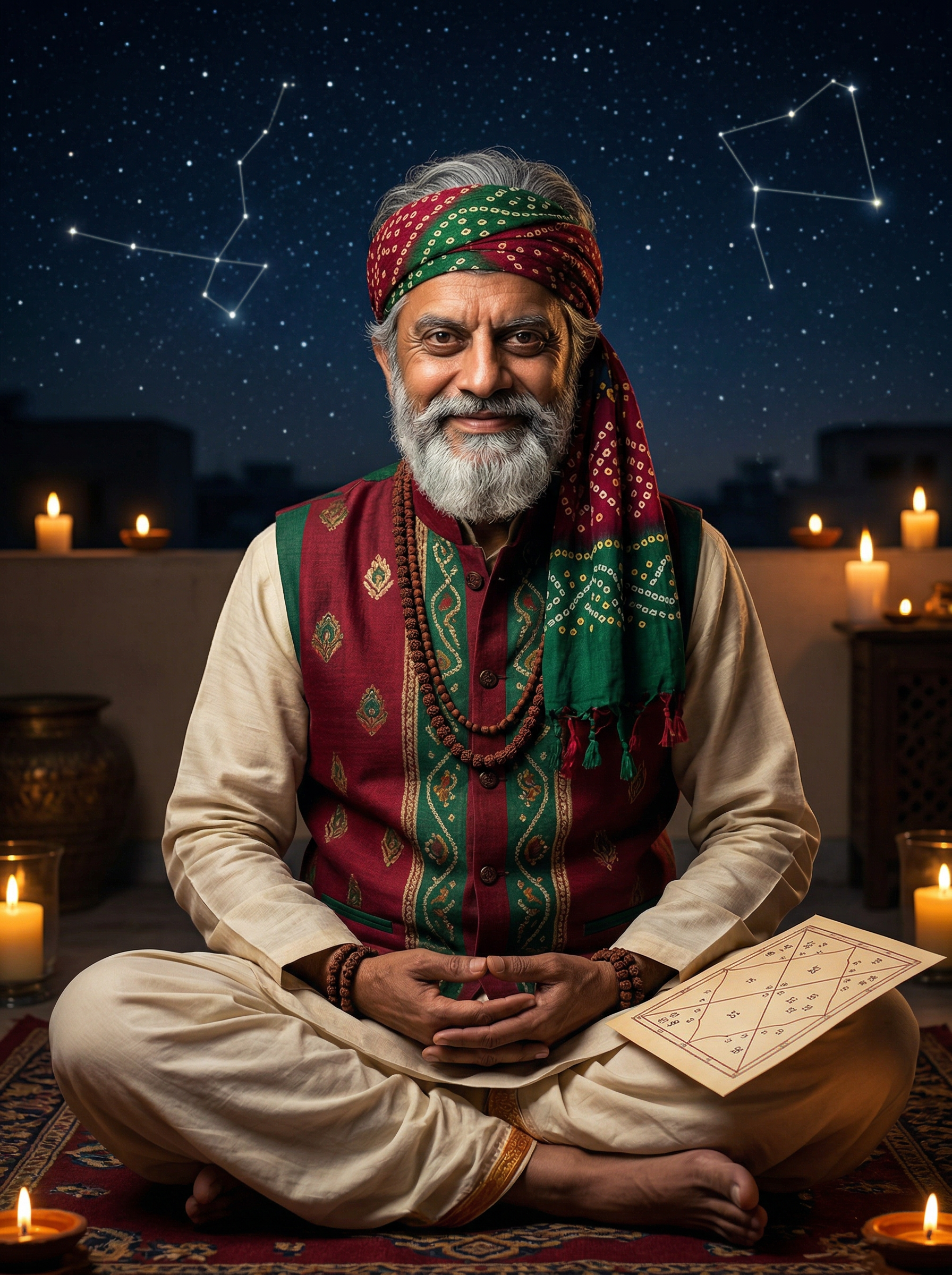
Jyotish — the science of light — has been read in India for more than three thousand years. Through your birth chart, it traces the sky at the moment you arrived: the Lagna (Rising Sign) that shapes your outer nature, the Moon that holds your inner world, the Dasha (Major Period) that names the chapter you are now living. I am Ashoka. I have spent a lifetime with this language. If you are ready, the sky has much to tell you, friend.
Sign in for full access — save your reading, track your dashas, and more.
Your Chart, read with Ashoka
Give Ashoka the four things the sky needs — your name, date, time, and place of birth — and he opens Your Chart: a guided walk through your Lagna (Rising Sign), the two lights, the shape of your houses, and the Dasha (planetary period) you're living now, each idea taught as he goes. Then return each day for a short reading of the sky moving across your chart.
Ashoka's Almanac
Today's Panchang
The five limbs of the day weave today's quality, friend. Return shortly.
Bhagavad Gita guide
All 700 verses of the Gita — Sanskrit, transliteration, and English translation — alongside Ashoka's personal commentary for each. A companion for study or for moments when one verse is enough.
Rasi name finder
For a newborn, the birth chart and Moon nakshatra hold the syllables most auspicious for the child's name. Ashoka will suggest names that honour these roots and carry meaning across Indian and Western cultures.
Jyotish works with nine lights. Seven you can see — the Sun, the Moon, Mars, Mercury, Jupiter, Venus, Saturn. Two you cannot — Rahu and Ketu, the shadow planets, the points where the Moon crosses the path of the Sun. Western astrology added Uranus, Neptune, and Pluto when telescopes found them. Jyotish did not. These nine have always been considered sufficient to describe a life.
The chart is a map drawn at the moment of your first breath. It does not move. What moves is time — and Jyotish measures time through the dashas, planetary periods that unfold across your life in a fixed sequence. Each graha (planet) governs a stretch of years: Ketu seven, Venus twenty, the Sun six, the Moon ten, Mars seven, Rahu eighteen, Jupiter sixteen, Saturn nineteen, Mercury seventeen. One hundred and twenty years in total. You will live through perhaps two or three complete cycles of the inner periods. The dasha you are in now is not a prediction. It is a season. It tells you which graha is speaking most loudly, which qualities of yours are being called forward.
The nine grahas are not abstractions. Each carries a name, a form, a story older than the texts that recorded it.
- Surya — the Sun. The king, and the self. His wife could not bear his full radiance, so she fashioned a shadow in her own likeness and withdrew into the forest. The shadow bore him children too — among them, Saturn. The distance between what is real and what is reflection runs through the Sun's placement in every chart.
- Chandra — the Moon. He married the twenty-seven nakshatras — daughters of the sage Daksha — but could not keep his eyes from Rohini alone. Daksha cursed him to wane. Shiva intervened: not to lift the curse, but to make the dying cyclical. This is why the Moon does not die. It only disappears for a while.
- Mangal — Mars. When the demon Hiranyaksha dragged the Earth to the floor of the cosmic ocean, Vishnu descended as a boar to retrieve her. Mars is the child of that rescue — son of Vishnu and the Earth herself. He is the commander-in-chief of the planetary army, and in his placement you find where a person will fight, and what they will protect.
- Budha — Mercury. The Moon fell in love with Tara, wife of Jupiter, and took her. The heavens went to war. When Brahma compelled the Moon to return her, Tara was pregnant. She would not say whose child it was. Mercury was born into silence, and has never stopped finding words since.
- Guru — Jupiter. The preceptor of the gods, possessor of divine wisdom. He moves slowly, taking a year to cross each sign. Where he sits in your chart, he expands. Where he looks, he blesses. He is the teacher who arrived before you knew you needed one.
- Shukra — Venus. The preceptor of the demons, and the only being in all three worlds who possesses the Mritasanjivani — the knowledge that restores the dead to life. He obtained it from Shiva after austerities no god would attempt. Jupiter knows wisdom. Shukra knows what it costs to keep living.
- Shani — Saturn. Son of the Sun and Chhaya, the shadow-wife. When Saturn was born, his father looked at him and saw not a son but a darkness. Saturn travels the slowest of all the grahas — two and a half years in each sign, thirty to circle the sky. He does not punish. He simply gives exactly what was earned. No more. No less.
- Rahu. During the churning of the cosmic ocean, the demon Svarbhānu disguised himself among the gods and drank the nectar of immortality. The Sun and Moon recognised him. Vishnu's discus severed his head from his body — but too late. The nectar had touched his lips. He became immortal, and became two. Rahu is the head: always hungry, always reaching, unable to swallow what he craves. He sits in your chart wherever you want most and have the least peace about wanting.
- Ketu. The body of the same demon, without its head. He cannot desire the way Rahu desires. He has already tasted immortality and found it unsatisfying. Where Rahu grasps, Ketu releases. He points back — to past lives, to what the soul has already mastered. In his placement you find what you came in knowing, and what you are quietly being asked to let go.
The dashas unfold from the Moon's nakshatra (lunar mansion) at your first breath, which determines your entry point into a fixed sequence — Ketu, Venus, Sun, Moon, Mars, Rahu, Jupiter, Saturn, Mercury — one hundred and twenty years in total. The sequence follows the order of the nakshatras across the sky; it was not chosen, it was found. The dasha you are living now is the chapter heading. Everything else in the chart is the text.
This is what Ashoka reads: the fixed map, and the moving season.