Seven hundred verses, read with a friend.
Sanskrit, plain English, and Ashoka's reflection on every verse — at your pace, in any order.
What the Gita is
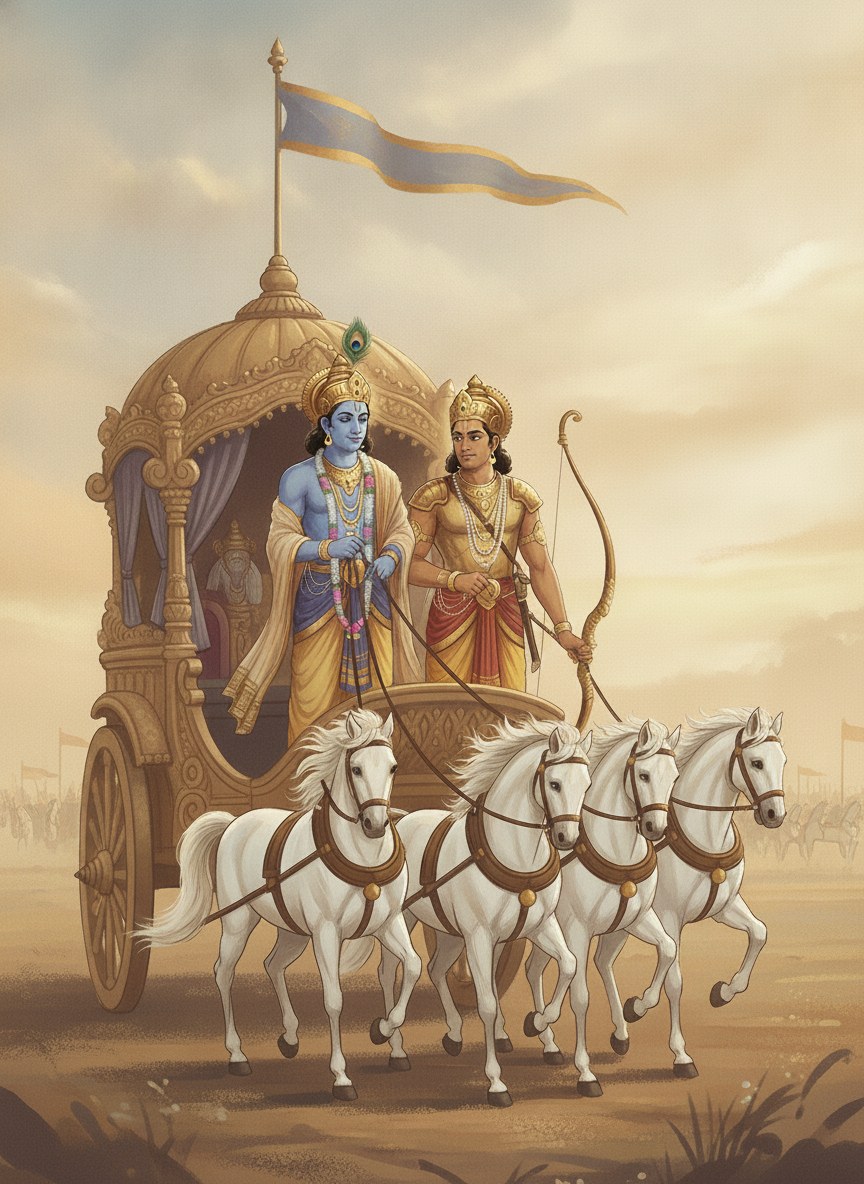
The Bhagavad Gita — the “Song of the Lord” — is a conversation of seven hundred verses between a warrior, Arjuna, and his charioteer, Krishna, on the morning of a war Arjuna cannot bring himself to fight. In answering Arjuna's despair, Krishna lays out the tradition's deepest teaching on action, duty, the self, and devotion. It is the most beloved and most quoted scripture of the Hindu world.
Where it sits — inside the Mahabharata
The Gita is not a separate book. It lives within the Mahabharata, the vast epic of one family torn in two, at the very moment the great war begins. The armies — cousins, teachers, elders — stand ready, and Arjuna asks Krishna to draw the chariot between them. What he sees breaks him, and he lowers his bow. Krishna's reply to that breakdown is the Gita: eighteen chapters, spoken between the lines of a battlefield.
How we read it here
Every verse carries its Devanagari Sanskrit, a transliteration, and an English translation (Swami Sivananda's) — we never alter the verse itself. Beneath it, Ashoka offers a short reflection: applied teaching, in plain words, that meets your life — never to frighten, shame, or sell you anything. Each Sanskrit term is glossed on first use. The reflections are written in Ashoka's voice as a study companion, not handed down as a guru's decree. Read more about our approach →
Start each chapter with its story
Read verse by verse and it is easy to lose the thread. So each of the eighteen chapters opens with a short orientation — where Arjuna stands, what Krishna turns to next, the arc of the chapter — so you always know where you are in the conversation.